
Last updated November 2, 2026
 Whole-home duct cleaning
 Dryer vent cleaning
 Camera inspection
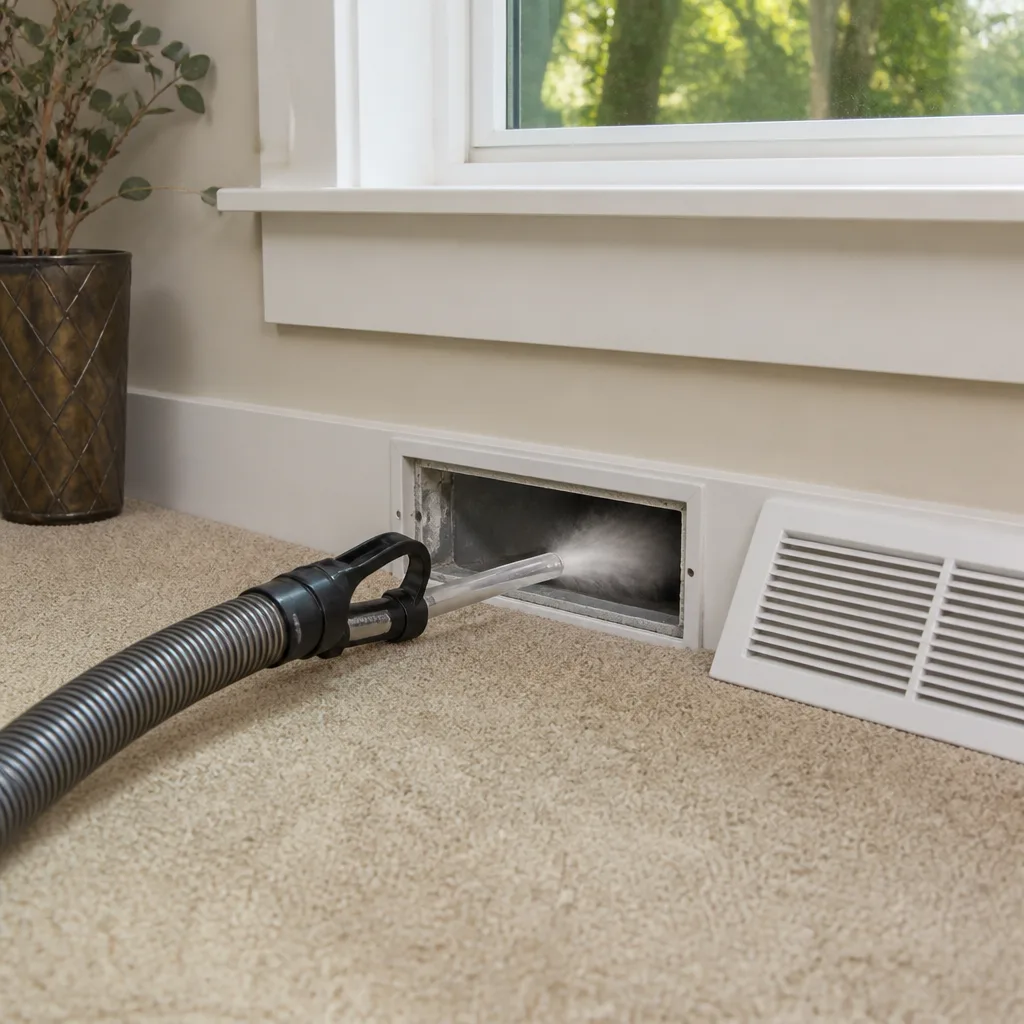 Sanitizing & deodorizing
Whole-system duct and dryer vent check with before-and-after photos - you see exactly what came out of your vents
That "$99 whole-house special" is a bait ad - the real number appears once they are in your hallway, or the "clean" is a shop-vac at the register. We photograph the inside of your ducts before and after instead.
Air Duct Cleaning Maintenance Checklist for Downey Homeowners
If your 1-inch pleated filter is loading up in under three weeks, your ducts aren’t just dirty – they’re actively shedding debris into your living space every time the blower kicks on. In Downey, where Santa Ana winds push fine particulate through every seam and the summer AC season runs long and hard, your ductwork accumulates material differently than it does in coastal communities. This guide gives you a working sequence of observable checks, tied to your home’s actual airflow behavior and seasonal exposure, so you can tell the difference between normal accumulation and a system that needs professional attention. You’ll learn which indicators you can track yourself and which require camera inspection to assess accurately.
Styles & brands we work with
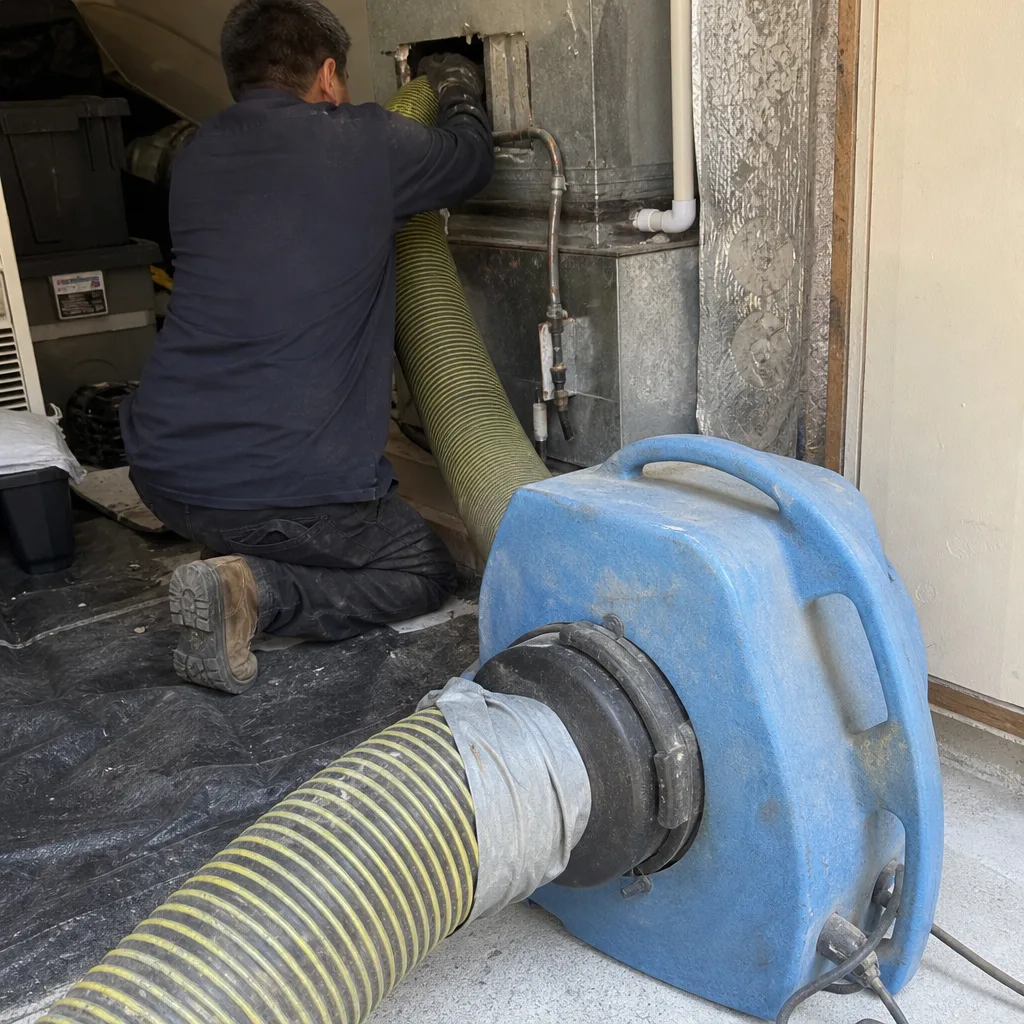
- Whole-home duct cleaning
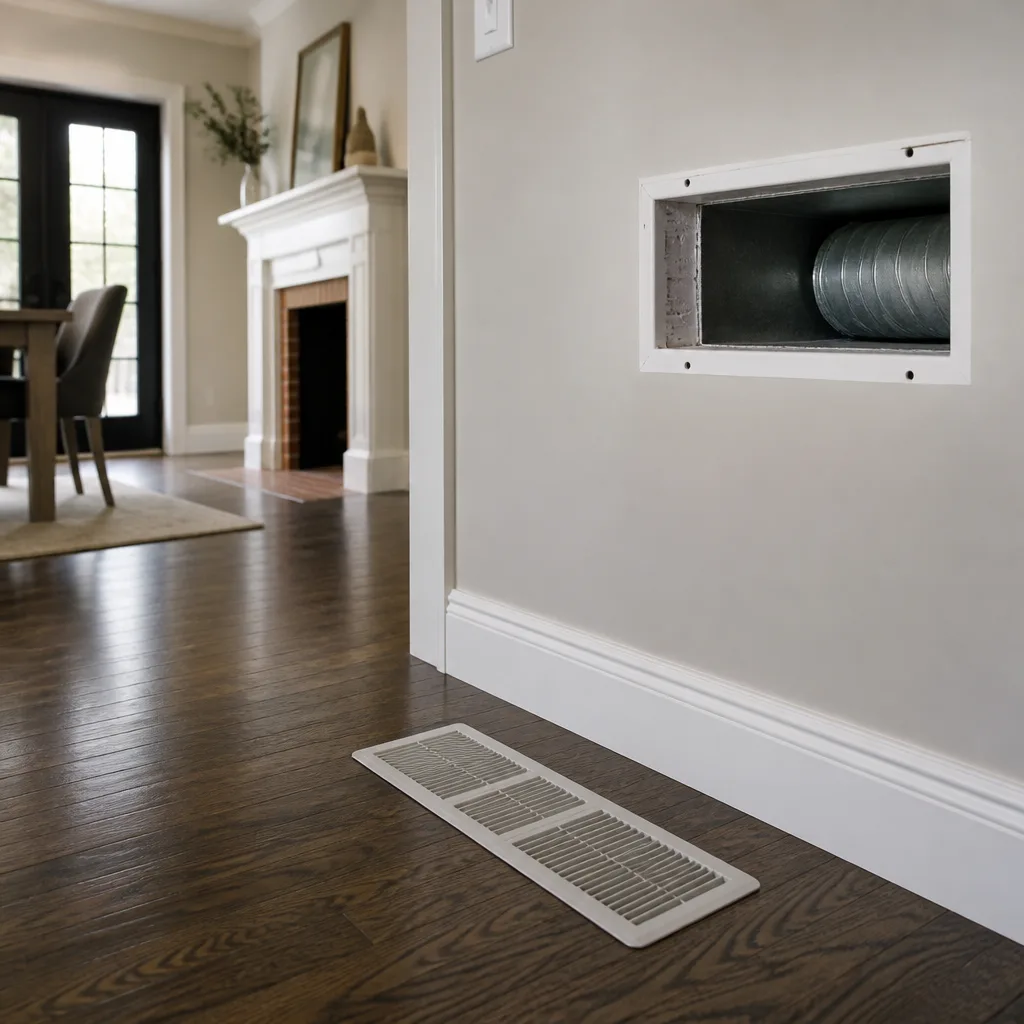
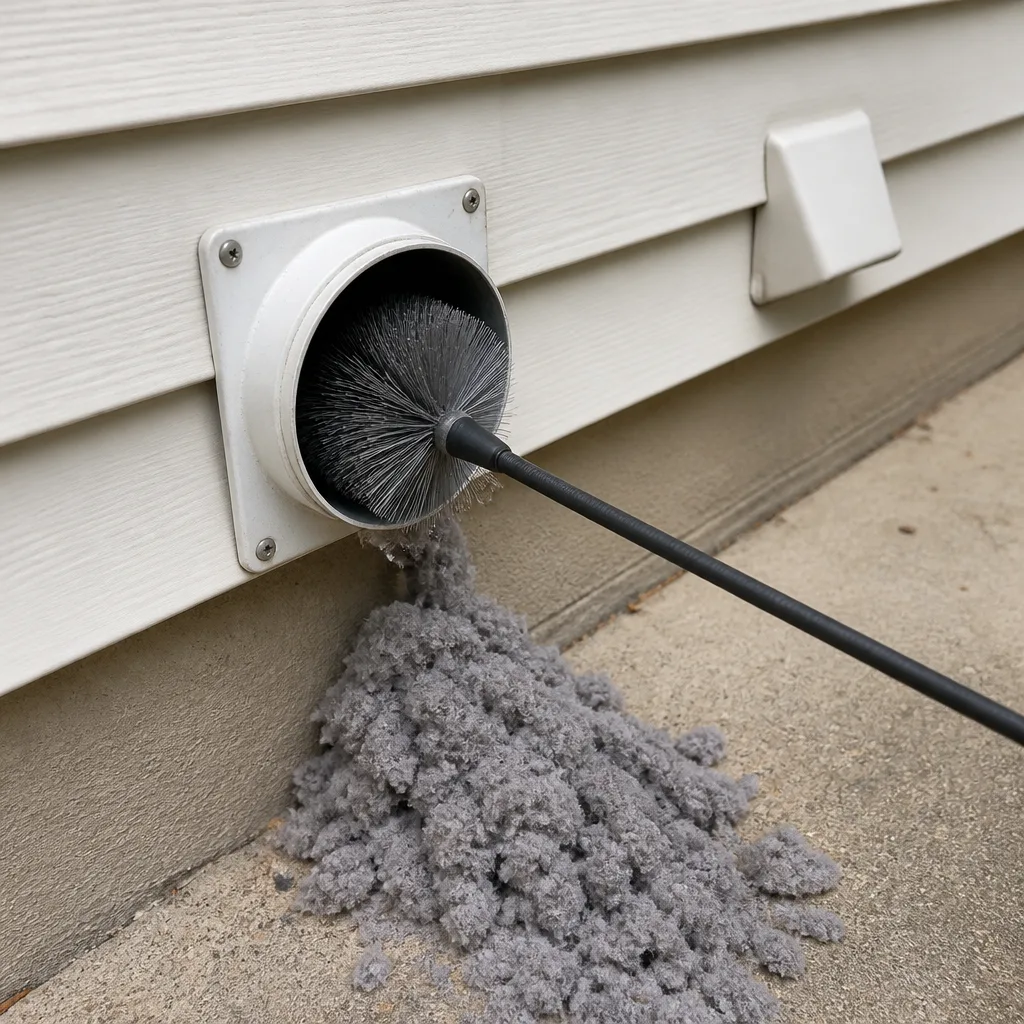
- Dryer vent cleaning
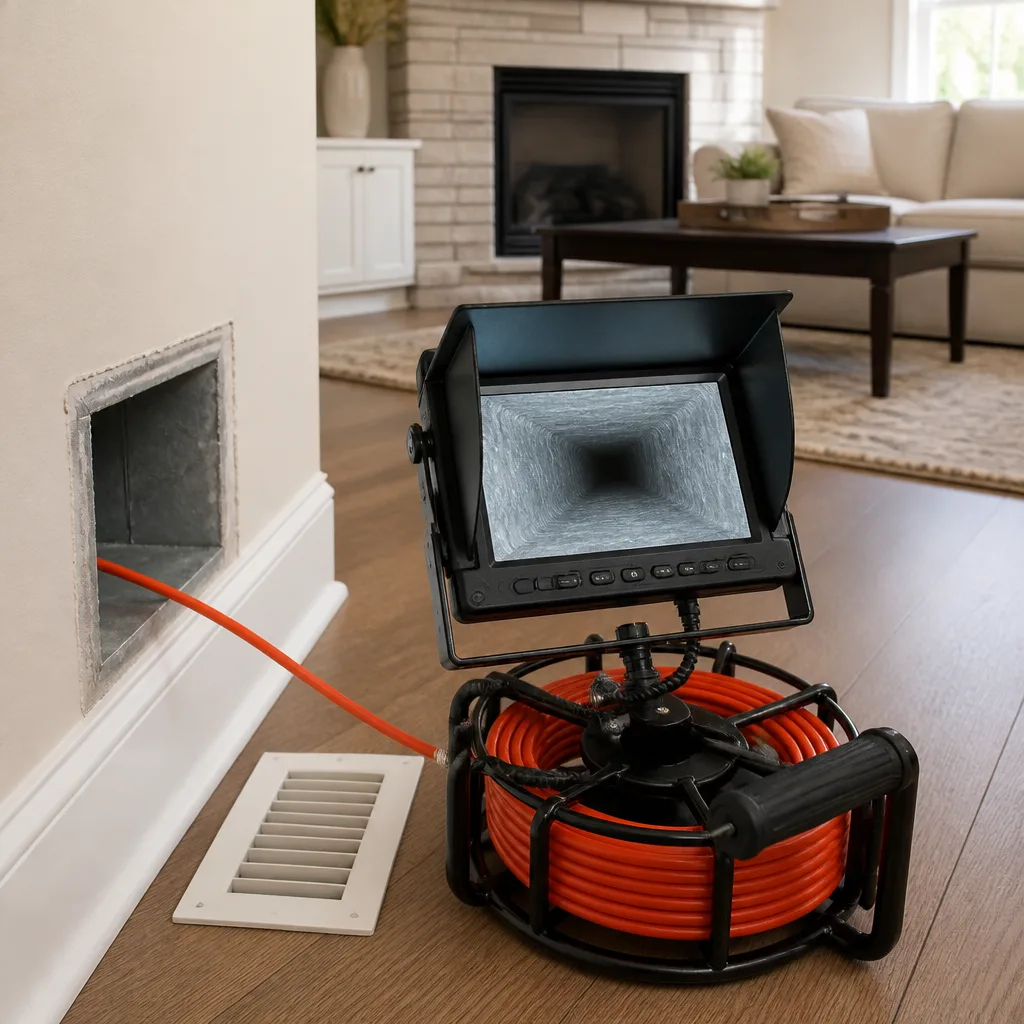
- Camera inspection
- Sanitizing & deodorizing
Quick Answer
A meaningful air duct maintenance routine for a Downey home tracks four things: filter load rate, airflow at each register, dust banding at the return grille, and seasonal changes in household dust. Track your filter weekly. Check register airflow with a tissue monthly. Inspect the return grille for banding patterns each quarter. And schedule a camera-inspected our Air Duct Cleaning services when filter load accelerates or airflow drops, typically every 2 to 4 years for most Downey properties.
Table of Contents
- Filter Load Rate: Your First and Most Honest Indicator
- Register Airflow Checks You Can Do With a Tissue
- Return Grille Dust Banding: Bypass Leakage vs. Surface Accumulation
- Downey Seasonal Checkpoints: Post-Santa Ana, Post-Summer, Post-Holiday
- Which Checklist Items Are DIY and Which Need a Camera Inspection
- The Dryer Vent Item Most Checklists Miss
- When Filter and Duct Cleaning Aren’t Enough: Air Quality Systems
- Common Mistakes to Avoid
- When to Call a Professional
- Frequently Asked Questions
- The Bottom Line
Filter Load Rate: Your First and Most Honest Indicator
Most Downey homeowners change their filter on a calendar schedule – every 30 days, every 90 days, whatever the packaging says. That’s a maintenance habit, not a diagnostic one. The real information is in how fast the filter loads relative to your household conditions. A 1-inch pleated filter in a typical Downey home with no pets and normal occupancy should take 6 to 8 weeks to show visible gray-brown loading across the pleats. If you’re seeing significant darkening in 3 weeks or less, something upstream is generating debris faster than normal – and ducts are the most common source.
To track this properly:
- Set a recurring calendar reminder every 7 days to visually inspect the filter.
- Photograph the filter each time you check it. Side-by-side weekly photos reveal loading rate far more accurately than memory.
- Note the pattern of discoloration. Even gray loading suggests normal household dust. Darker streaking at the center of the filter suggests debris concentrated in the return air path, which often correlates with duct contamination in the return trunk.
- Track the gap between filter changes. If the interval shortens by more than 30 percent without a change in occupancy, pets, or renovation activity, the supply side of the system is likely shedding.
We’ve seen this play out in Downey repeatedly: a homeowner blames the filter brand, switches to a more expensive option, and the loading rate barely improves. The filter isn’t the problem. The material lining the interior of the ductwork is. A full air duct cleaning in Downey removes that reservoir; no filter swap will.
Register Airflow Checks You Can Do With a Tissue
Blockages in ductwork rarely announce themselves. They show up as a register that feels slightly weaker than the others, a room that runs a degree or two warmer, a faint whistling sound at a supply grille. You can quantify this with a single-ply tissue and 10 minutes on a day when the AC or heat is running.
- Turn the system fan to “On” at the thermostat so airflow is continuous while you test.
- Hold a single-ply tissue 6 inches from each supply register. Observe how far the tissue deflects. It should move decisively.
- Compare registers in rooms of similar size, on the same floor. A register that deflects the tissue half as much as its peer is signaling a problem: a kinked flex run, a disconnected section, or a partial blockage in that branch line.
- Check the return path too. At the return grille, a tissue held 2 inches away should be pulled firmly against the grille. A weak pull means restricted return airflow, which forces the blower to work harder and pulls negative pressure that draws unfiltered air through any gap in the duct system.
- Repeat the test in each room and note the weakest locations. That’s your map of suspect branches.
This is a diagnostic observation, not a repair. If you find a weak register, the next step is a camera inspection to see what’s actually in that branch line. The fix may be cleaning, or it may be air duct repair in Downey if the duct itself is crushed, disconnected, or leaking. The tissue test tells you where to look; it doesn’t tell you what you’re looking at.
Return Grille Dust Banding: Bypass Leakage vs. Surface Accumulation
The return grille is the most honest surface in your entire HVAC system. Supply registers blow conditioned air into rooms; return grilles pull room air back into the system. Everything that collects on a return grille has been pulled out of the air you breathe – and the pattern of collection tells a story.
When you examine the return grille, look for two distinct patterns:
- Surface accumulation: a uniform gray film across the face of the grille. This is normal household dust drawn by return airflow. It’s expected and manageable with regular wiping.
- Dust banding at the edges: concentrated dark lines where the grille meets the wall or ceiling. This is not normal. Banding at the perimeter indicates bypass leakage – air being pulled around the filter, not through it. That air carries whatever is in the wall cavity, ceiling joist space, or unconditioned area directly into the duct system without filtration.
In our experience with Downey homes, bypass leakage at return grilles is more common in houses built before 1990, where the return may be an open stud bay or a sheet metal pan nailed to joists rather than a sealed ducted return. Those cavities collect decades of dust, and when the return is poorly sealed, the blower pulls that material into the house every cycle. Wiping the grille face won’t fix it. The leak point needs to be sealed, and the return path needs to be cleaned properly – with professional equipment, not a household vacuum.
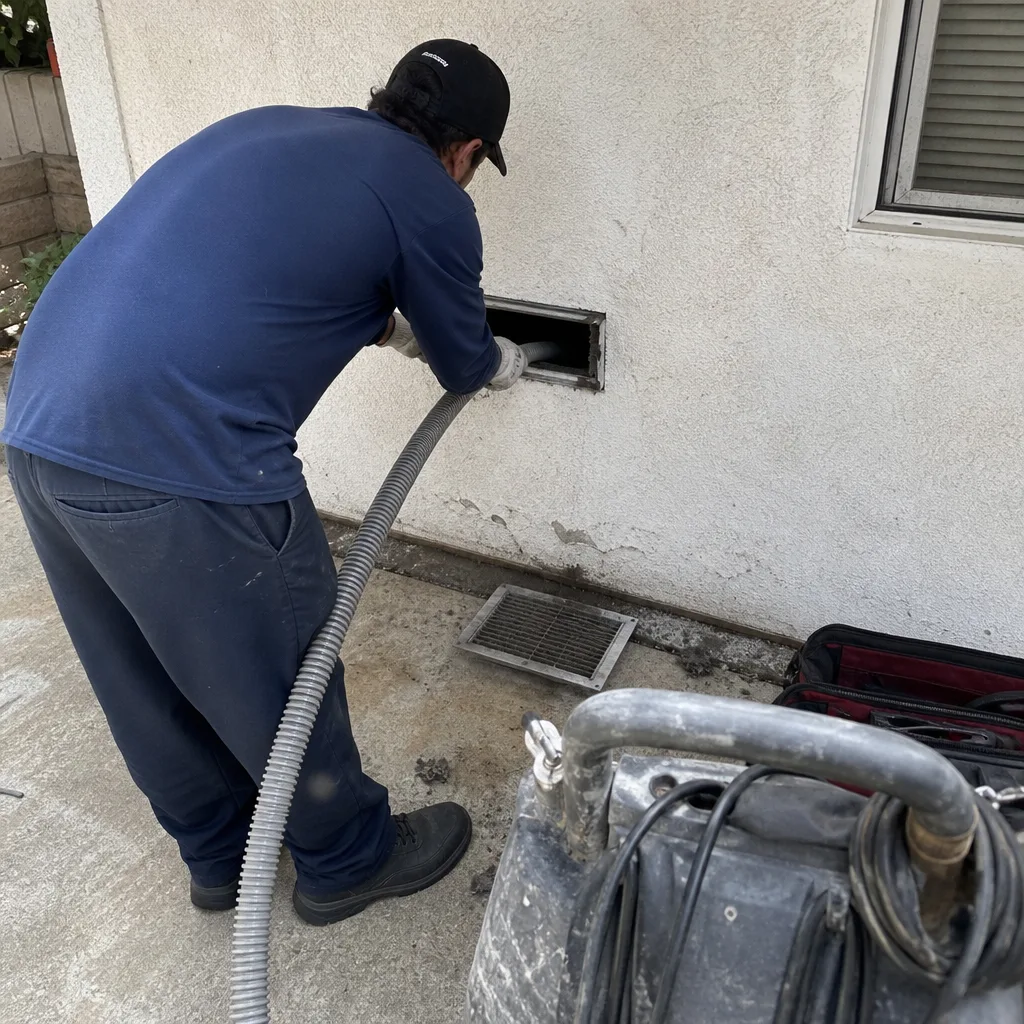
This is where the hardware matters. When we clean return trunks in Downey homes, we’re running Rotobrush and Nikro professional duct-cleaning systems simultaneously – brush agitation and negative-air collection working together so dislodged material is captured, not redistributed into the living space. The same categories of problems are consistent across the Duct Cleaning Downey home service area: older construction, bypass leakage, and residential systems that have never seen a real cleaning.
Downey Seasonal Checkpoints: Post-Santa Ana, Post-Summer, Post-Holiday
Ductwork doesn’t accumulate debris evenly across the year. It accumulates in seasonal pulses, and in Downey those pulses are predictable. Build your checklist around them.
Post-Santa Ana Wind Season (October through February)
Santa Ana winds push fine dust, pollen, and wildfire smoke particulate through every exterior penetration in a Downey home. The HVAC system isn’t pulling outdoor air directly, but pressure differentials around windows, doors, and wall penetrations draw that fine material into wall cavities and unconditioned spaces – which then feeds into duct leaks. After the first major Santa Ana event of the season, check your filter at the 2-week mark. If it’s darker than expected, the fine particulate has found a path into your system. Also inspect exterior dryer vents during Santa Ana season; windborne lint and debris can build against the exterior flap and prevent it from closing properly.
Post-Summer AC Season (September)
Downey summers mean long compressor run times. Long run times mean the blower cycles hundreds of times per week, pulling air through the filter and the entire duct network. Accumulated dust compacts in the ductwork; condensation cycles during humid periods can turn surface dust into a matt-like film that adheres to duct walls. In early fall, do a full register airflow check using the tissue method above. Compare it to the same check from spring. Any register that has weakened over the summer likely has heat-compacted material restricting that branch.
Post-Holiday Interior Activity (January)
The holiday season brings a sharp but overlooked spike in indoor particulate: candles, cooking (especially high-heat roasting), a tree shedding needles in the living room, winter gatherings, more indoor occupancy. It’s also the season when Downey homes run the furnace more frequently. In January, inspect the return grille for banding specifically – the interior particulate spike shows up first at the return, because that’s the first surface the system pulls air across. If banding appears at the return edges in January, note it; that’s bypass leakage that’s been present all along, now visible because of the seasonal particulate load.
Which Checklist Items Are DIY and Which Need a Camera Inspection
A useful maintenance checklist is honest about its limits. Some observations you can make with your eyes and a tissue. Others require seeing inside the ductwork, which means a camera. Here’s the split.
Genuinely DIY:
- Weekly filter inspection and load rate tracking
- Monthly register airflow comparison with a tissue
- Quarterly return grille inspection for banding patterns
- Seasonal filter changes (or more frequent, based on your tracked load rate)
- Visual inspection of supply registers for accumulated dust on the directional vanes
- Checking the dryer vent exterior flap for full closure and airflow
Requires professional camera inspection:
- Confirming actual duct contamination behind a high filter load rate. You can’t see the inside of a duct from the register.
- Diagnosing the source of weakened register airflow. Partial blockages in branch lines are invisible from outside the system.
- Assessing the return trunk for debris accumulation, especially in joist-cavity returns common in older Downey construction.
- Verifying whether visible dust at return grilles is surface film or bypass leakage driven by a failed seal.
- Evaluating duct integrity for separation, holes, or damage that should be handled as air duct repair in Downey rather than cleaning.
- Confirming the dryer vent is clear of lint buildup more than 10 feet from the exterior opening, where homeowner tools can’t reliable reach.
The step most Downey homeowners skip is the camera confirmation before a cleaning. A professional who skips the camera is guessing. A professional who runs a camera first knows exactly which branches are impacted, whether there’s moisture damage, and whether repair is needed before cleaning can be effective.
The Dryer Vent Item Most Checklists Miss
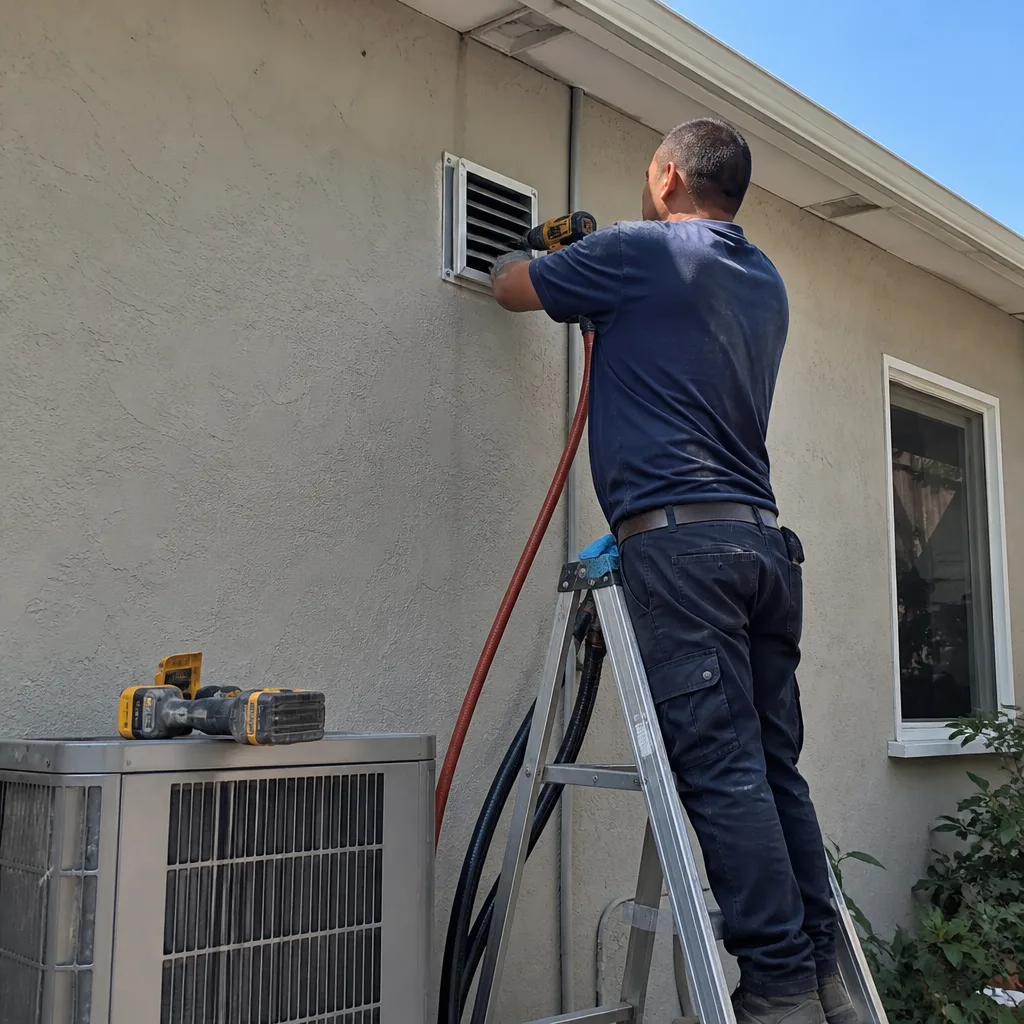
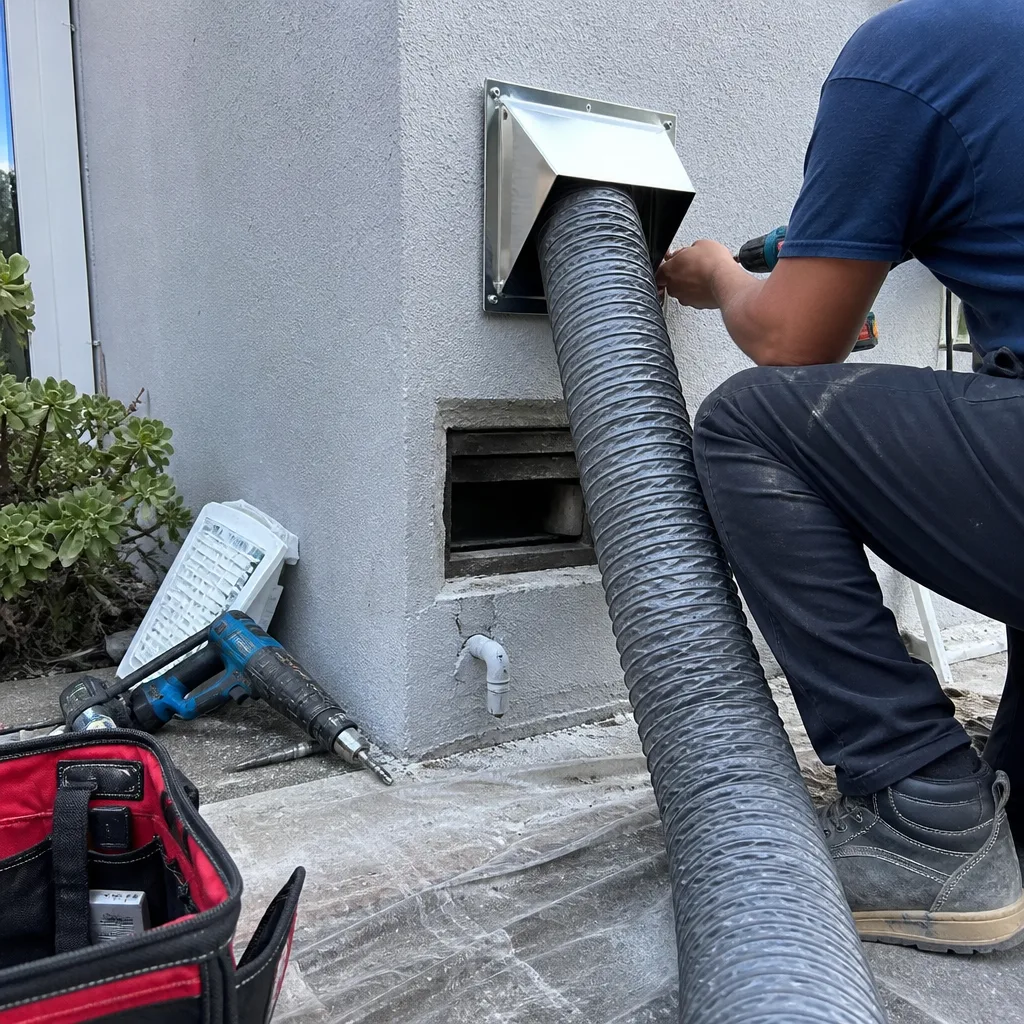
Dryer vent cleaning lives on a different checklist than air duct cleaning, but the two are connected in ways most Downey homeowners don’t consider. Your dryer pushes air out of the house under positive pressure. That air carries lint. Where the dryer vent passes through a wall cavity or ceiling joist space, any gap in the vent pipe leaks lint directly into those unconditioned spaces – the same spaces that feed duct bypass leakage into your HVAC return. Lint in the wall cavity is a fire hazard. Lint pulled into the duct return is an air-quality problem. Both can be happening simultaneously.
The maintenance item most checklists miss: confirming the dryer vent pipe is continuous and sealed along its entire run, not just clear at the exterior opening. A homeowner can clear the last 2 feet of a vent with a brush and think the job is done, when the real restriction is 8 to 12 feet in, at a joint or elbow where the pipe has separated inside the wall. That’s the scenario where a partial dryer vent cleaning in Downey that only addresses the terminal section creates false confidence.
We address both systems as connected, because they are. A full dryer vent service should include confirming the vent run is intact – not just clearing lint. And when we find a dryer vent that’s leaking into a wall cavity adjacent to a return duct, we flag both issues so the homeowner understands the full picture.
When Filter, Duct Cleaning, and Vent Work Aren’t Enough
Some Downey homes have ductwork in good condition, an honest load rate, and an HVAC system that’s working properly, yet the occupants still struggle with dust, allergy symptoms, or generally heavy indoor air. That’s the signal that the problem isn’t debris in the ducts – it’s the ongoing filtration and air treatment capacity of the system itself.
A standard 1-inch filter protects the equipment, not the occupants. It captures the large particulate that would otherwise foul the blower and coil, while finer material passes through into the living space. For homes where that fine material is a persistent concern – allergy sufferers, homes near busy Downey corridors, properties with dust-generating conditions – the upgrade path is a dedicated air quality system. We service and install Honeywell and Aprilaire air quality units, including whole-home media filtration, electronic air cleaners, and humidification where it serves the system’s balance. These are installed at the equipment, treating the full air stream rather than one room.
This is also where our Abatement Technologies filtration equipment matters during cleaning. We run HEPA-filtered negative-air machines during duct cleaning service – the same equipment category used in environmental and remediation work. That means the cleaning process itself doesn’t discharge fine particulate into the living space. It’s captured. That’s a higher contamination standard than a basic vacuum-and-brush pass.
Common Mistakes to Avoid
- Changing filters on a calendar without tracking load rate. A Downey home with two dogs will load a filter in a month; the same home with no pets might go 8 weeks. If you don’t track, you don’t know your baseline, and you can’t see when that baseline shifts toward a duct problem.
- Replacing a fast-loading filter with a “better” filter instead of investigating why. A high-MERV filter just obstructs airflow more; it doesn’t address the debris reservoir. You’re treating the symptom and stressing the blower at the same time.
- Wiping the return grille face and calling it maintenance. The face film is surface dust; the problem is the banding at the edges that signals bypass leakage around the filter. Wiping doesn’t touch that.
- Assuming every register should feel the same. Long branch runs in larger Downey homes naturally deliver less air than short runs. The tissue test is comparative – same room size, similar run length – not a demand for uniformity across a 2,400-square-foot floor plan.
- Treating duct cleaning as a routine calendar item. Frequency should be driven by filter load rate, airflow measurement, and camera findings – not by a generic “every 3 years” rule. Some Downey homes need more frequent attention; some go far longer legitimately.
- Cleaning the dryer vent’s exterior 3 feet and considering it done. The real restrictions are mid-run, at joints and elbows. Terminal cleaning creates false confidence.
- Believing a cheap cleaning with a shop-vac and a brush has the same result as professional negative-air cleaning. Dislodging material without capturing it just moves the dust around. Professional results require professional collection.
When to Call a Professional
You should schedule a professional assessment when your filter load rate accelerates by more than 30 percent in a single season, when the tissue test reveals a register that’s dropped significantly relative to its peers, when return grille banding appears or worsens, or when you smell a musty odor when the blower first kicks on. Any of those signals indicates something inside the system that you can’t see from the outside. Duct Cleaning Downey offers free estimates in Downey – call (855) 382-4683 to schedule a camera inspection before committing to any cleaning or repair work.
Frequently Asked Questions
Most Downey homes benefit from professional duct cleaning every 2 to 4 years, but the real answer depends on your filter load rate, register airflow, and whether you have pets, renovation history, or a pre-1990 home with joist-cavity returns. Track your filter weekly; if you see loading accelerate, schedule a camera inspection to determine whether cleaning is warranted. Call (855) 382-4683 for an exact assessment – estimates are free.
Whole-system air duct cleaning for a typical Downey home generally falls in the range of $350 to $700, depending on the number of registers, the number of systems, the degree of contamination, and whether repairs are needed. Any quote given without a camera inspection of the system is a guess. We quote one flat price per system after inspection, before any work begins.
Because they’re quoting a different service: a vacuum-and-brush pass on the visible portion of the system, not a negative-air cleaning that captures dislodged material throughout the trunk and branches. We run Rotobrush and Nikro professional systems with Abatement Technologies HEPA negative-air filtration simultaneously, which costs more to operate and delivers a result a shop-vac can’t replicate. Cheap quotes typically rise once the technician arrives; ours doesn’t.
Demand before-and-after camera documentation of the interior of the trunk and branch lines. Any company that won’t show you the inside of your ducts before and after isn’t doing the kind of cleaning that warrants the label. Photographic proof is the only verification that matters. We provide it as standard.
You can clean the visible surfaces – registers, grilles, the first few inches of duct behind them. You cannot clean the interior of the trunk line or branch runs without professional equipment, and attempting to reach them with household tools risks dislodging material into the airstream and damaging duct surfaces. The DIY portion of maintenance is observation: filter tracking, tissue tests, grille inspection. The cleaning itself belongs to a professional.
It can contribute, but it’s not a standalone allergy solution. Cleaning removes the accumulated reservoir of dust and allergens that recirculates through the living space; ongoing air quality treatment – filtration and air-quality systems like Honeywell or Aprilaire units – manages the new particulate that enters the system every day. The two work together. We’d be glad to discuss the full picture at (855) 382-4683.
The Bottom Line
Your Downey ductwork gives you information through the surfaces you can see: the filter, the registers, the return grille. The filter load rate tells you how fast debris is being generated. The tissue test tells you whether every branch is delivering air. The return grille banding tells you whether air is bypassing the filter entirely. Track those three indicators through Downey’s seasonal pulses – post-Santa Ana, post-summer, post-holiday – and you’ll know when your system needs professional attention before it fails or fouls your air. See Air Duct Cleaning Permits, Codes & Inspections in CA: What You Need to Know to understand regulatory requirements. And when you do call, make sure the company runs a camera first and captures dislodged material with negative-air equipment. Anything less is a partial answer to a whole-system question.
Written by the team at Duct Cleaning Downey, serving Downey since 2017. Explore more guides & resources from our team.
See the difference
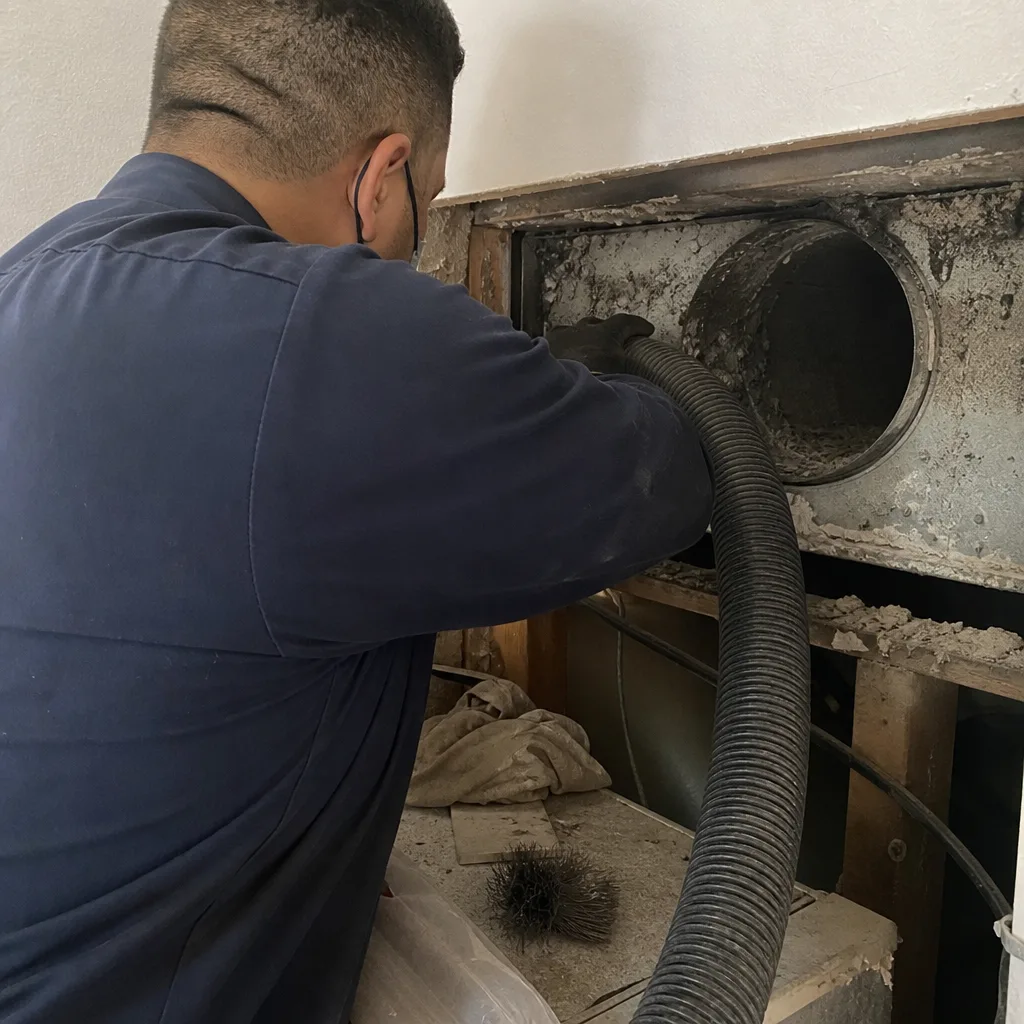 Before
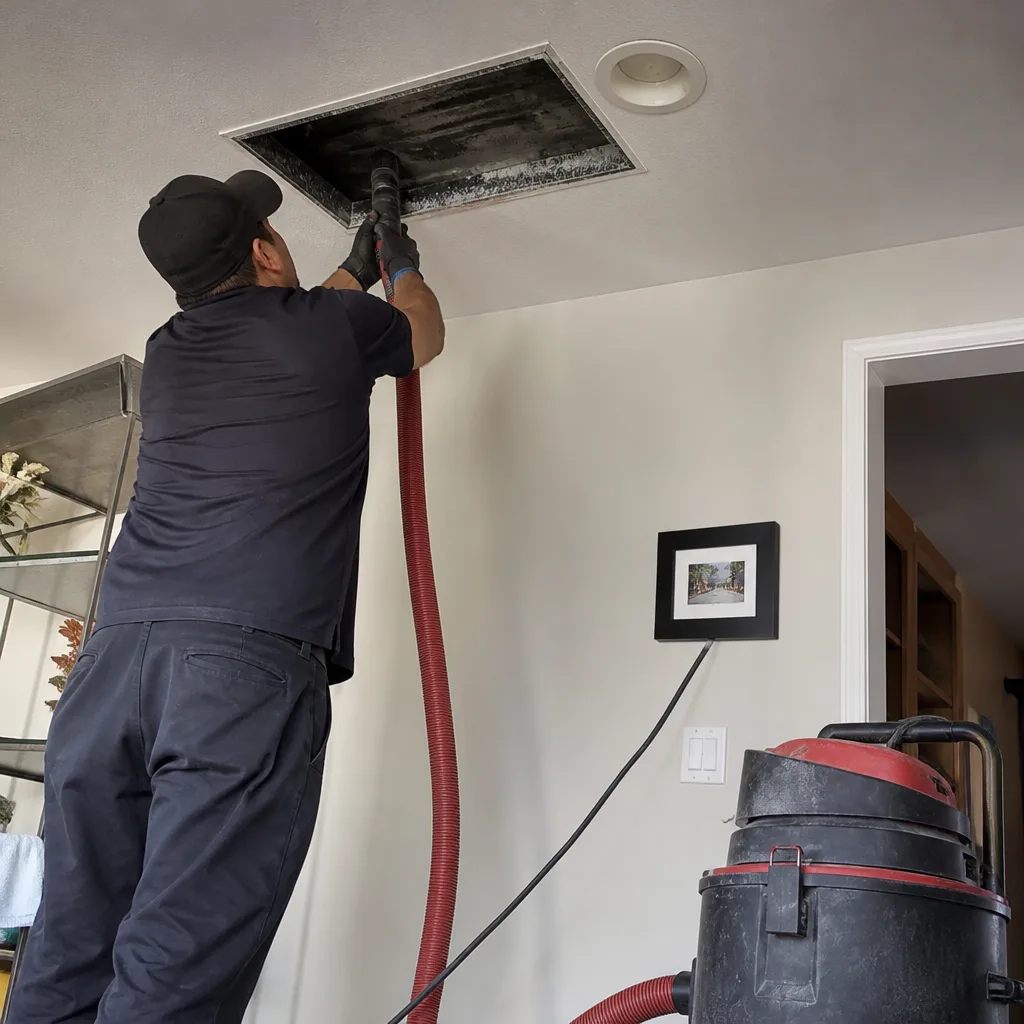 After
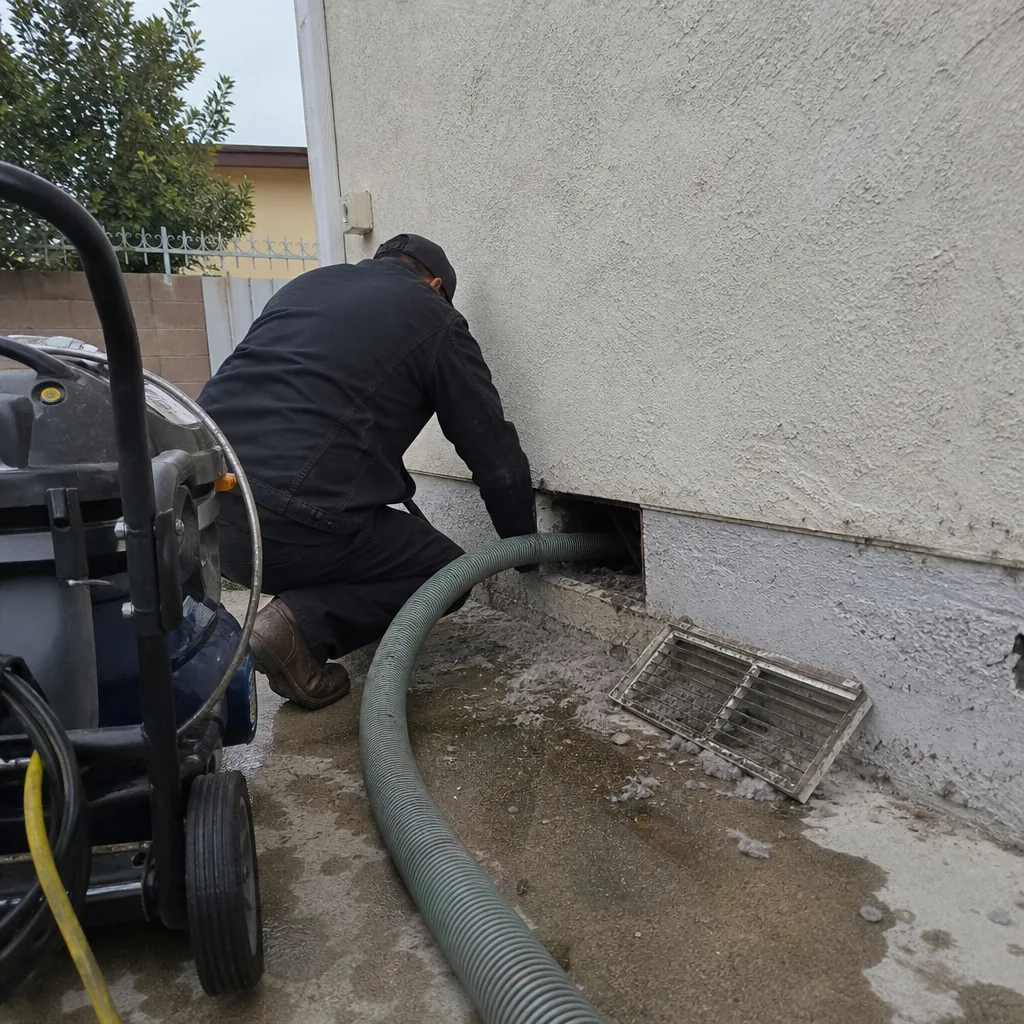 Before
 After
 Before
 After